The Invisible Clock: Why Urgency Matters in Huntington’s Disease Research
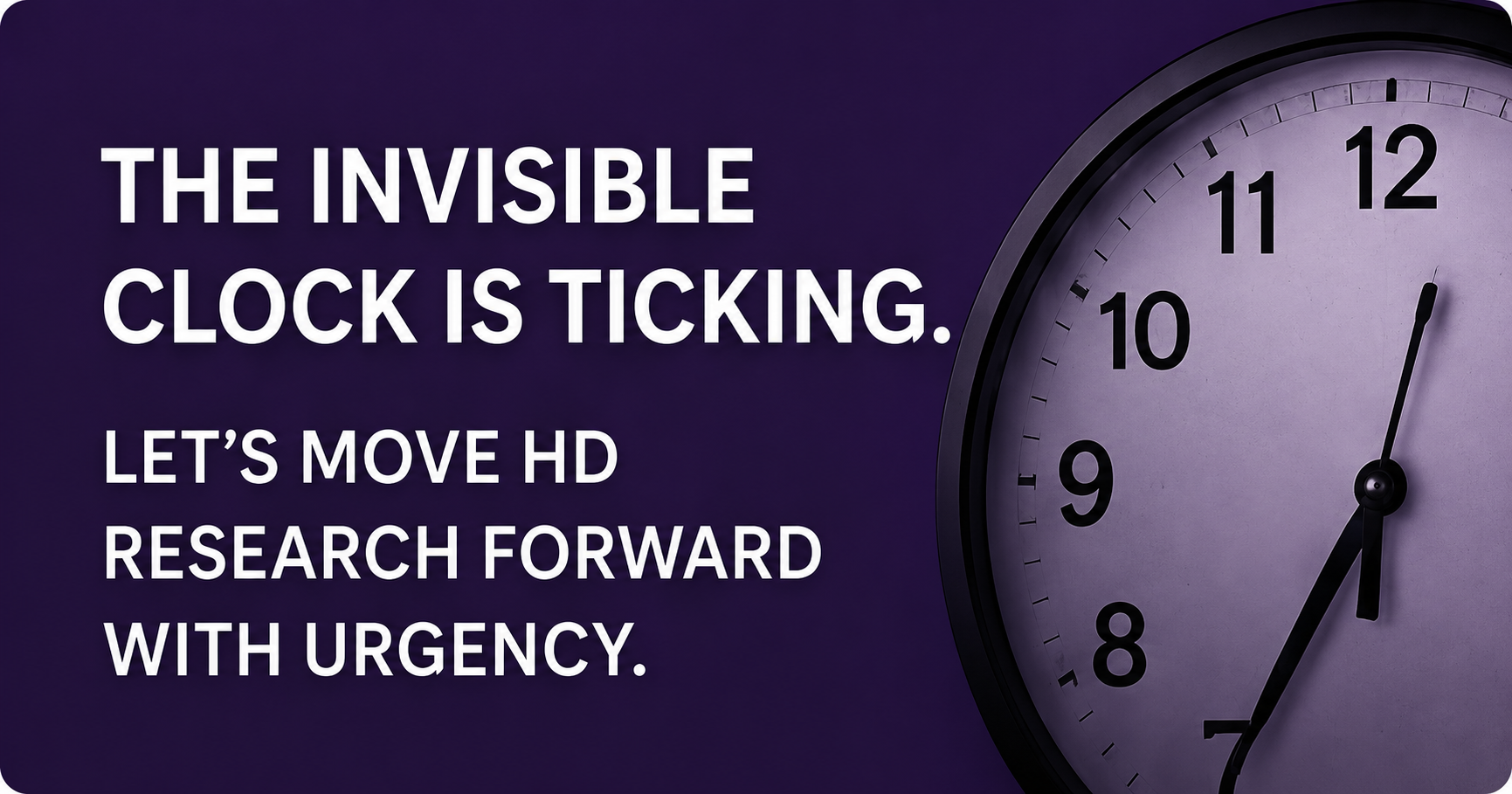
For those of us connected to Huntington’s disease (HD), time is never abstract.
Every year matters because HD does not wait while research moves forward. We see it when a friend becomes more withdrawn or apathetic, when cognitive or behavioral changes begin affecting relationships and daily life, or when someone starts losing their independence. We see people we care about changing while knowing that time and abilities lost to HD cannot simply be restored.
For those of us who carry the HD gene but have not yet developed noticeable symptoms, there is also an invisible clock quietly ticking in the background. Even when we appear healthy, the uncertainty is always there. We do not know exactly when symptoms will begin, how quickly they may progress, or whether an effective treatment will arrive before we need it. Each year without a treatment is another year closer to the possibility that HD could begin changing our lives.
There is real reason for hope. It is encouraging to see many companies investing in HD and potential treatments advancing through different stages of clinical development. But even with that progress, I still find myself asking the same question: Will a treatment arrive in time for me and for my friends in the HD community?
When first learning about HD 17 years ago, I was told that a treatment was right around the corner. In 2015, I remember a researcher confidently telling a group of young adults that a treatment could be available within a few years.
More than a decade has passed since that conversation. During that time, I have lost friends to HD and watched others progress. Some may now be too far along to qualify for clinical trials or benefit from future treatments. “Almost there” feels different when you have been hearing it for more than a decade.
Scientific research takes time, and clinical trials must be safe, thoughtful, rigorous, and designed to determine whether a treatment is effective. But we should also continue asking whether there are unnecessary barriers or delays that could be addressed.
Partner With the Community Early and Often
One of the most important ways to strengthen clinical development is to involve patients and families before major study decisions have been made. Too often, the community is asked for feedback after a protocol is largely finalized. At that point, there may be limited opportunity to make meaningful changes.
Patients and caregivers can help researchers understand whether study visits are realistic, whether the participation burden is manageable, and whether the outcomes being measured reflect what truly matters in daily life.
A statistically meaningful result is important. But patients also want to know whether a treatment could help them continue working, driving, communicating, maintaining relationships, and living independently.
These perspectives should complement the expertise of clinicians and researchers. Meaningful partnership requires listening to a range of people impacted by HD and showing them how their feedback influenced the study.
Continue Examining Who Can Participate
I understand why clinical trials need specific inclusion and exclusion criteria. They are important for protecting participants, reducing avoidable risk, and ensuring that a study can answer its scientific questions.
At the same time, those criteria cannot be so restrictive that they make it unnecessarily difficult to enroll a study.
Each requirement should be carefully considered. Is it necessary for safety? Is it essential to the research question? Or could it unintentionally exclude people who may otherwise be able to participate?
Overly narrow criteria can contribute to enrollment delays. Each day a study is delayed can mean a longer wait for the community to learn whether a potential treatment works and, if successful, whether it can eventually become available.
I would participate in a clinical trial if I could, but I often do not qualify because I am not considered “sick enough.” At the same time, people with more advanced symptoms may be excluded because they are considered too far progressed.
That creates a narrow window for participation.
We also know that biological changes associated with HD can begin years before a person reaches what is traditionally considered clinical onset. That raises an important question: Should we be doing more to study potential treatments earlier, before significant function has been lost?
There may be scientific, regulatory, and practical challenges to doing so. But given the progressive nature of HD, it is a question worth continuing to explore.
Meet the Community Where They Are
Clinical sites play an essential role in research, but trial awareness should not depend on sites alone.
Many people in the HD community receive information through trusted patient organizations, webinars, social media, and conversations with their HD specialists or doctors. Trial awareness efforts should reflect those realities and meet people where they already are.
Patient organizations and community leaders can help make information easier to understand, raise awareness among people who may not be connected to a study site, and identify common questions or concerns about participation.
The goal should not be to persuade someone to join a study. It should be to make sure people know that the opportunity exists, understand what participation involves, and have enough information to decide whether it may be right for them.
What Greater Urgency Can Look Like
Greater urgency does not mean moving carelessly. It means being intentional about where time may be lost and where the research process can be strengthened.
Three areas could make a meaningful difference:
Measure what matters to patients. Study outcomes should reflect what a treatment could help someone continue doing in everyday life, such as spending meaningful time with their children, cooking a meal, staying employed and financially stable, maintaining friendships along with family and romantic relationships. These are the changes that can have the greatest impact on a person’s independence, identity, and quality of life.
Make trials easier to understand and access. Information should be clear, participation requirements should be realistic, and awareness efforts should reach people through the sources they already know and trust.
Partner with the community early and often. Patients and caregivers should be involved before major decisions are made and throughout the study, not only after the protocol has been finalized.
The patient community also has an important role to play.
Patients, caregivers, and advocates can continue sharing their experiences, asking difficult questions, participating in advisory opportunities, and raising awareness about research. Patient organizations can help bring forward a wider range of voices, including those who may not already be closely connected to research centers.
For a research program, one year may mean another analysis, protocol amendment, or enrollment extension.
For someone with HD, one year may mean losing the ability to work, drive, communicate clearly, live independently, or care for their family.
That difference matters.
I think about my mom, the friends we have lost, and the people who were once told that a treatment was only a few years away.
I also think about my own invisible clock.
I am grateful that so many companies, researchers, clinicians, advocates, and community members are working toward potential treatments. That progress gives me hope. But I still wonder whether it will come in time for me and for the people I care about in the HD community.
One day, I may follow a similar path unless an effective treatment arrives in time. I hope it does, but there are no guarantees. The HD community has contributed its time, data, stories, energy, and hope to research for decades. The field must continue treating that time as the precious and limited resource that it is.
The views expressed here are my own and are based on my personal experience as a member of the Huntington’s disease community.